
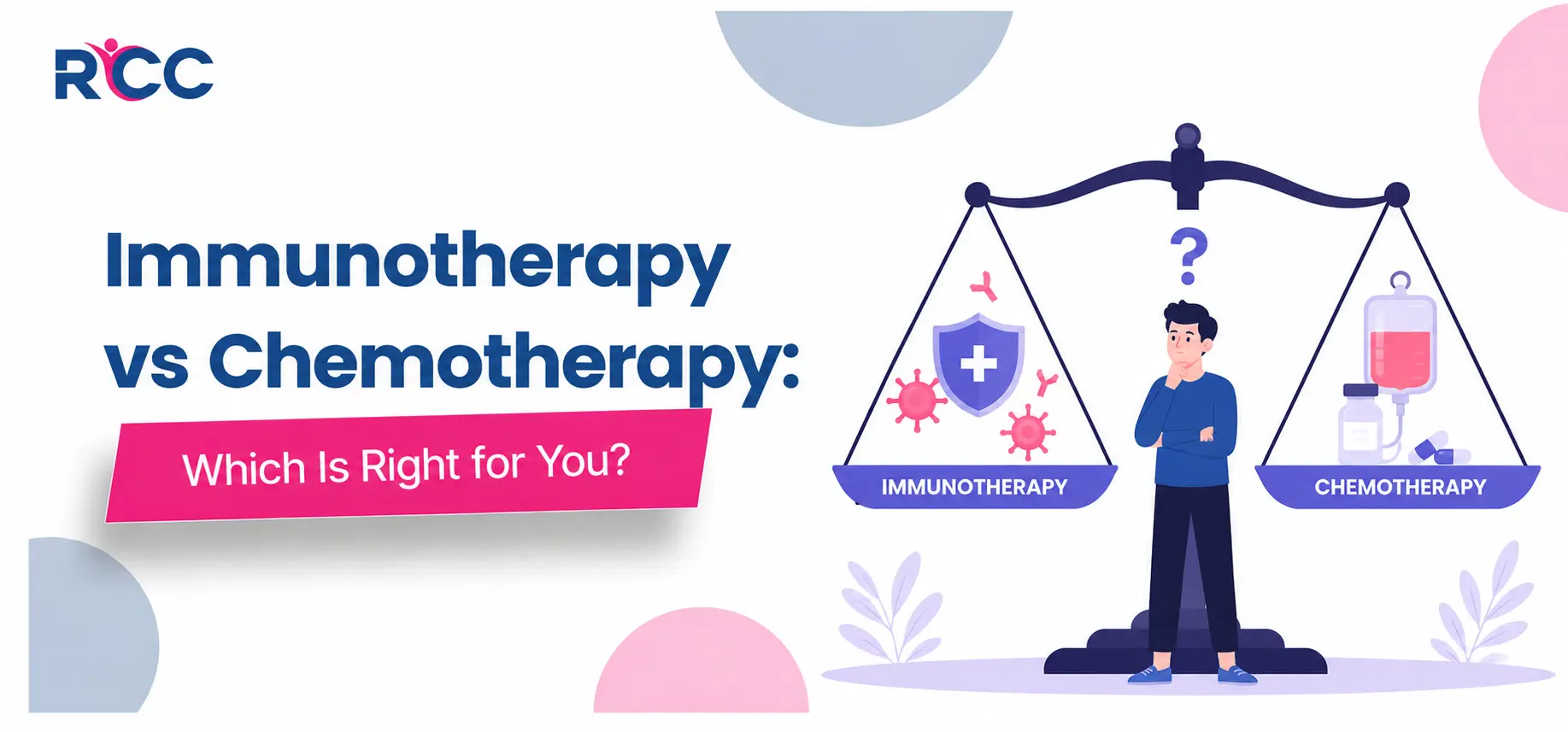
“Immunotherapy,” when heard by many people, may bring about visions of the future where advanced medicine cures people using smart drugs and treatments without any pain and discomfort unlike chemotherapy. So it is quite natural for patients to be curious and question their oncologist, “If immunotherapy is the future then why does my doctor recommend chemotherapy?” It is important to note that there is no specific treatment for cancer. Both chemotherapy and immunotherapy save lives, but operate entirely differently from each other depending upon various factors including the type of cancer, its stage, genetic markers, patient’s health and more. This blog post aims to help you know everything about both these methods and how oncologists choose one over another. Read ahead in light of the expert advice of Dr. Rishabh Jain, who treats his cancer patients in Jaipur with AIIMS training in oncology.
What is Chemotherapy?
Chemotherapy treatment where medicines are used to kill the rapidly proliferating cancer cells. When you ask an oncologist, “What is chemotherapy?” he may describe it to you in simple words as a treatment where abnormal cells dividing at a rapid pace are killed using powerful chemicals.
In order to understand the chemotherapy, it can be compared with a broad-spectrum antibiotic. Similarly to antibiotics that kill multiple types of bacteria even some beneficial types chemotherapy aiims at targeting quickly multiplying cancerous cells, but it also impacts some normal fast-growing cells, such as hair follicle cells, stomach lining cells, and bone marrow cells. This is the reason why patients undergoing the therapy can suffer from side effects.
Some of the common chemotherapy protocols applied in the clinics headed by a physician like Dr. Rishabh Jain include FOLFOX in gastrointestinal cancer, CHOP in lymphomas, and carboplatin in certain other cancers, like lung and ovarian cancer. These depend upon the type and the stage of cancer and the general health condition of the patient.
It is suggested in most cases of solid tumors irrespective of their stages, especially when there is an urgent need to reduce tumor size or prevent its spread. Some common side effects of chemotherapy include hair loss, nausea, tiredness, sores in the mouth, and compromised immune system. Modern supportive medications, however, can help manage most of these side effects effectively.
What is Immunotherapy?
One of the most advanced forms of treatment for cancer is immunotherapy. Unlike chemotherapy that works by destroying cancer cells, immunotherapy aids the patient’s immune system in recognizing and eliminating cancer. The problem with cancer cells is that they evade the body’s immune defenses by turning them off. With immunotherapy, this is reversed, thus enabling the body’s immune system to act against cancer.
In very simple terms, you can think of chemotherapy as being general, while immunotherapy can be likened to training a special force to track a target slow to get started but much more accurate.
In cancer clinics run by professionals like Dr. Rishabh Jain, some of the common immunotherapies administered include checkpoint inhibitors such as Pembrolizumab and Nivolumab these are either administered individually or in combination with chemotherapy or targeted therapy. This treatment modality is highly effective when dealing with cancer cases involving the lungs, melanoma, bladder, and cervix cancers, especially those that are PD-L1 positive.
However, there are certain groups of people who do not respond positively to this treatment method. While some may achieve great results with immunotherapy, its effectiveness is seen in only about 20 – 40% of people. Hence, biomarker testing is crucial before the initiation of treatment. Immunotherapy’s side effects tend to be less severe than those of conventional chemotherapy, although they can manifest as fatigue, rash, thyroid abnormalities, organ inflammation, and even autoimmune reactions, where the immune system starts attacking healthy cells.
difference between immunotherapy vs chemotherapy
| Parameter | Chemotherapy | Immunotherapy |
| How it works | Cytotoxic drugs that target rapidly dividing cells, both malignant and normal | Checkpoint inhibitors that restore T-cell mediated tumour surveillance and cytotoxicity |
| Target | All fast-dividing cells including bone marrow, gastrointestinal mucosa, and hair follicles | Tumour-specific antigens identified through biomarker profiling (PD-L1, TMB, MSI-H) |
| Best for | Pancreatic, GI, and most solid tumours; early and advanced stage disease requiring rapid cytoreduction | Non-small cell lung cancer, melanoma, bladder, cervical, and MMR-deficient tumours |
| Common side effects | Alopecia, chemotherapy-induced nausea and vomiting (CINV), myelosuppression, peripheral neuropathy | Immune-related adverse events (irAEs) including pneumonitis, colitis, endocrinopathies, rarely severe autoimmune reactions |
| Duration | Fixed cycles (usually 3 to 6 months); response assessed by imaging every 2 to 3 cycles | Ongoing until disease progression or toxicity; durable responses may persist beyond treatment cessation |
| Success indicator | Objective response rate (ORR), tumour shrinkage on CT or PET scan within weeks | Durable complete response, progression-free survival; pseudoprogression possible before true response |
| Cost in India | Approx. INR 20,000 to 1,50,000 per cycle depending on regimen | Approx. INR 1,50,000 to 4,50,000 per cycle for anti-PD-1 or anti-PD-L1 agents |
Which Treatment Is Right for You? Five Factors That Determine the Answer
This is the question that matters most, and there is no single answer that applies to every patient. The decision depends on a convergence of clinical, molecular, and patient-specific factors. Here is how oncologists think through it.
Factor 1: Cancer Type and Histology
Certain cancers respond predominantly to chemotherapy, not because immunotherapy is ineffective in principle, but because the immunological environment of those tumours does not support a checkpoint inhibitor response. Pancreatic ductal adenocarcinoma, most gastrointestinal malignancies including gastric and oesophageal adenocarcinoma without MSI-H status, and most primary brain tumours remain largely chemotherapy-dependent.
On the other hand, non-small cell lung cancer (NSCLC) with high PD-L1 expression, cutaneous melanoma, urothelial carcinoma of the bladder, triple-negative breast cancer, and cervical carcinoma are tumour types where immunotherapy, either alone or in combination, has demonstrated significant progression-free and overall survival benefits in Phase III randomised controlled trials.
Factor 2: Biomarker Results
Biomarker testing is the single most important determinant of immunotherapy eligibility. Three biomarkers are currently clinically actionable in most solid tumours.
PD-L1 expression, measured by immunohistochemistry using validated companion diagnostic platforms such as the 22C3 assay for pembrolizumab, is expressed as a tumour proportion score (TPS) or combined positive score (CPS) depending on the tumour type. In NSCLC, a TPS of 50 percent or higher qualifies a patient for first-line pembrolizumab monotherapy. In cervical cancer, a CPS of 1 or higher qualifies for pembrolizumab in the first-line setting alongside chemotherapy.
Tumour mutational burden (TMB), measured in mutations per megabase by next-generation sequencing (NGS), reflects how many somatic mutations a tumour carries. High TMB (TMB-H), defined as 10 mutations per megabase or higher, is associated with a greater neoantigen load and, consequently, a higher probability of immunotherapy response across tumour histologies.
Microsatellite instability (MSI-H) and mismatch repair deficiency (dMMR) are pan-tumour predictive biomarkers. Pembrolizumab is FDA-approved for any MSI-H or dMMR solid tumour regardless of histology, which was the first tissue-agnostic oncology approval in history. This is a critically important biomarker to test for, particularly in colorectal, endometrial, and gastric cancers.
Factor 3: Stage of Disease
Stage influences the treatment intent, which in turn shapes the modality choice. In early-stage resectable disease, neoadjuvant or perioperative chemotherapy is often standard, with immunotherapy sometimes added in specific contexts such as resectable NSCLC or triple-negative breast cancer with high-risk features. In advanced or metastatic disease, the treatment is palliative in intent and the focus shifts to maintaining quality of life while prolonging survival, which is where immunotherapy’s durability becomes particularly valuable if the biomarkers are favourable.
Factor 4: Patient Health and Comorbidities
A patient with pre-existing autoimmune conditions such as rheumatoid arthritis, systemic lupus erythematosus, or inflammatory bowel disease carries a higher risk of severe immune-related adverse events and may not be suitable for checkpoint inhibitors. Similarly, a patient with compromised renal function requires dose adjustment of renally cleared cytotoxic agents, and hepatic dysfunction affects the pharmacokinetics of anthracyclines and taxanes.
Age alone is not a contraindication to either modality. However, performance status, as assessed by the ECOG scale, and the patient’s physiological reserve are central to treatment tolerance and must be factored in.
Factor 5: Speed and Durability of Response Required
This is a nuanced but important consideration. Chemotherapy typically produces objective radiological responses within 2 to 3 treatment cycles, making it the preferred choice when rapid tumour shrinkage is clinically necessary, for instance when a large mediastinal mass is compromising airway function or when hepatic metastases are threatening organ failure.
Immunotherapy, by contrast, can take 3 to 6 months before a definitive response is assessable, and in a subset of patients, pseudoprogression occurs, where the tumour appears to grow transiently before shrinking. The upside is that when immunotherapy produces a complete response, that response is often durable and can persist for years without ongoing treatment.
Combination Chemoimmunotherapy
An important and increasingly common third option is the combination of chemotherapy and immunotherapy administered concurrently. This approach is now standard of care for several indications including advanced NSCLC without EGFR or ALK driver mutations regardless of PD-L1 level, advanced triple-negative breast cancer with PD-L1 positivity, and advanced cervical carcinoma. The rationale is that chemotherapy-induced immunogenic cell death may enhance tumour antigenicity and augment the immune response initiated by checkpoint blockade. These combinations are supported by Phase III data and are incorporated into current NCCN and ESMO guidelines.
Cancer-Specific Treatment Guidance
The following is a brief overview of how treatment decisions are made for cancer types we commonly treat at Rishabh Cancer Care. Each of these sections links to a dedicated page on our website with more detailed information.
Breast Cancer
For triple-negative breast cancer (TNBC), which lacks oestrogen receptor, progesterone receptor, and HER2 expression, pembrolizumab combined with chemotherapy has demonstrated a statistically significant improvement in event-free survival in both the neoadjuvant and metastatic settings. PD-L1 CPS testing is mandatory before initiating pembrolizumab in metastatic TNBC. Hormone receptor-positive and HER2-positive subtypes are generally managed with endocrine therapy, targeted agents, and chemotherapy, with immunotherapy having a more limited role at this time.
Lung Cancer
Non-small cell lung cancer represents one of the strongest indications for immunotherapy. NSCLC without actionable driver mutations and with PD-L1 TPS of 50 percent or higher is now treated with pembrolizumab monotherapy as the preferred first-line standard per NCCN guidelines. For patients with lower PD-L1 expression or with driver mutations such as EGFR, ALK, or ROS1, targeted therapy or chemoimmunotherapy combinations take precedence. Platinum-doublet chemotherapy remains essential in driver-positive disease after targeted therapy resistance.
Cervical Cancer
Pembrolizumab has demonstrated improved overall survival when combined with platinum-based chemoradiation in locally advanced cervical cancer, and alongside chemotherapy with or without bevacizumab in the first-line metastatic setting, provided the tumour is PD-L1 positive (CPS of 1 or higher). Cisplatin-based chemoradiation remains the backbone of curative-intent treatment for locally advanced disease.
Blood Cancers: Lymphoma and Leukaemia
For haematological malignancies including Hodgkin lymphoma, diffuse large B-cell lymphoma, and acute leukaemias, conventional chemotherapy regimens such as ABVD, R-CHOP, and cytarabine-based induction remain the primary treatment approach. Checkpoint inhibitors have demonstrated activity in classical Hodgkin lymphoma after failure of conventional therapy. CAR-T cell therapy, a distinct form of cellular immunotherapy, is increasingly being evaluated in relapsed or refractory B-cell lymphoma and paediatric ALL. We assess eligibility for these approaches on a case-by-case basis.
Gallbladder and Gastrointestinal Cancers
For gallbladder carcinoma, cholangiocarcinoma, and colorectal cancers without MSI-H status, platinum-based and fluoropyrimidine-based chemotherapy regimens remain the standard systemic treatment. Targeted therapy with agents such as olaparib for BRCA-mutated pancreatic cancer, or FGFR inhibitors for FGFR2-fused cholangiocarcinoma, is increasingly relevant. MSI-H colorectal cancer, however, is a strong exception and is now considered a frontline immunotherapy indication.
FAQ Section
Q: Is immunotherapy better than chemotherapy?
It does not always have to be so. While there is a potential for long-lasting outcomes when using immunotherapy in certain cancers, chemotherapy remains superior in other tumours. What matters is a proper choice based on the specifics of the case.
Q: Can chemotherapy and immunotherapy be given together?
Yes, quite the opposite. In fact, a chemo and immunotherapy combination is currently used to treat certain cancers as it leads to better efficacy.
Q: How do I know if I am eligible for immunotherapy?
A patient’s eligibility is established by means of biomarker test, which includes assessment of PD-L1, MSI-H or high TMB.
Q: What are the side effects of immunotherapy vs chemotherapy?
The most common adverse effects of chemotherapy are alopecia, nausea, fatigue and low immune system. As far as the adverse effects of immunotherapy go, they usually involve the immune system and range from skin rashes and fatigue to organ inflammation or even hypothyroidism.
Q: Is immunotherapy available in Jaipur?
Yes, there are advanced forms of immunotherapy in Jaipur, such as Pembrolizumab and Nivolumab provided by doctors such as Dr. Rishabh Jain.
Q: How much does immunotherapy cost in India?
As far as the immunotherapy cost goes, it is rather high compared to chemotherapy and depends on a number of factors such as type of medication, type of cancer, its severity, etc.
About the Author
Dr. Rishabh Jain is a Medical Oncologist in jaipur trained at the All India Institute of Medical Sciences (AIIMS), New Delhi, one of India’s foremost academic medical institutions. He currently practises at Rishabh Cancer Care, Jaipur, where he specialises in the management of solid tumours and haematological malignancies, molecular oncology, and precision medicine. He is experienced in the administration and monitoring of both conventional chemotherapy and novel immunotherapy regimens.